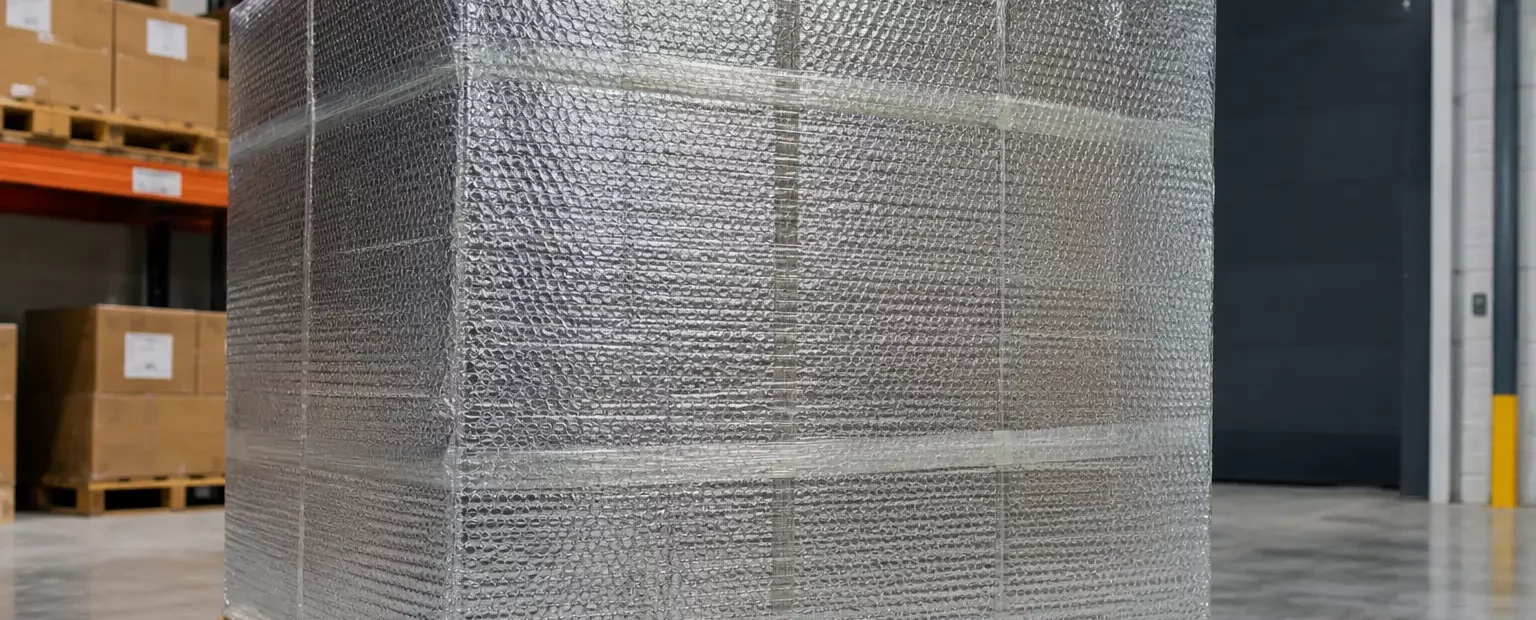
Reflective bubble wrap is a packaging material that combines an air-bubble structure with a reflective outer layer. This construction helps protect goods against impacts, abrasion and temperature changes during storage or transport.
It is particularly useful for palletized goods that are sensitive to temperature, solar radiation or environmental fluctuations. It does not replace a refrigeration system, but it helps reduce thermal exposure and adds a layer of mechanical protection around the load.
At Foamland, we have been manufacturing packaging materials in Sabadell since 1987. This experience has taught us that effective protection does not depend solely on the material itself. How it is applied, which surfaces it must cover and the risks the goods will encounter throughout their journey are equally important.
What is bubble wrap?
Bubble wrap, also known as air bubble film, consists of plastic sheets between which small air pockets are encapsulated.
These pockets create a lightweight, flexible structure that absorbs part of the energy generated by impacts, vibrations and localized pressure. For this reason, bubble wrap is used to wrap products, separate parts, cover surfaces and protect goods during handling.
Bubble size, number of layers, thickness and laminated materials may vary depending on the application. A heavy metal part does not require the same solution as a box of electronic components or a pallet temporarily exposed outdoors.
Within our range of bubble wrap rolls for packaging, we offer different configurations to adapt protection to the weight, volume, surface sensitivity and logistical conditions of each type of goods.
What makes reflective bubble wrap different?
Reflective bubble wrap includes a metallized or reflective outer face. This layer changes how the material behaves when exposed to thermal and solar radiation.
Standard bubble wrap mainly protects against impacts, vibrations, dust and abrasion. The reflective version adds a barrier that helps limit heat transfer by radiation. The air layer also provides additional thermal resistance.
The result is a material that combines two functions:
- Mechanical protection through the air pockets.
- Passive thermal protection through the reflective surface.
This combination explains why it is also known as thermal bubble wrap, insulating bubble wrap, reflective bubble wrap or metallized bubble film. Although these terms are often used interchangeably, the exact composition may vary from one product to another.
Before choosing a material, it is advisable to check the type of laminate, thickness, strength and expected level of exposure. A metallized appearance alone is not enough to assess its overall performance.
How does it protect palletized goods?
Palletized goods may be exposed to impacts, vibrations, abrasion, dust, ambient humidity and temperature changes. Reflective bubble wrap creates a protective envelope around the load and reduces its direct exposure to several of these factors.
Cushions impacts and vibrations
The air bubbles act as small cushioning points. They help reduce direct contact between the load and other elements in the logistics environment, such as walls, edge protectors, other pallets or handling equipment.This protection is useful for products with delicate surfaces, printed boxes, painted parts, industrial components or goods that may become marked during transport.
At our factory, we often find that damage does not always result from a single strong impact. Many defects are caused by repeated minor vibrations and friction over several hours of transport. A properly selected intermediate layer can prevent this cumulative damage.
Reduces friction between packages
When a pallet contains several boxes or parts, movement during transport may cause friction between them. Bubble wrap can be used as an outer covering or as a separator between layers to prevent direct contact.It can also protect corners and exposed faces before other packaging elements are applied.
Limits exposure to solar radiation
The reflective surface redirects part of the radiation that reaches the packaging. This helps reduce heating caused by temporary sun exposure, for example while waiting at a loading dock, moving between warehouses or during an outdoor logistics operation.It does not turn the pallet into a cold chamber or maintain a constant temperature on its own. Its purpose is to reduce heat gain or loss as part of a properly designed packaging system.
- Helps protect against temperature changes
The combination of a reflective face and an air layer restricts part of the heat exchange with the surrounding environment. It can be useful when goods must pass through areas with different temperatures or remain for a limited period in spaces without climate control.For products with strict cold-chain requirements, reflective bubble wrap should be considered a complementary solution. Transit time, starting temperature, acceptable temperature range, vehicle type and the possible need for ice packs or other systems must also be assessed.
- Protects against dust and dirt
When the load is fully covered, the material also acts as a physical barrier against dust, splashes and the dirt commonly found in warehouses and logistics platforms.Its level of water protection depends on how the covering is closed and joined. A wrap that is open at the bottom or poorly overlapped cannot be considered watertight.
Bubble wrap does not stabilize a pallet on its own
Protection and load securing should be treated as separate functions. Bubble wrap cushions, covers and insulates, but it does not normally provide the tension needed to immobilize a load on a pallet.
Once the protective material has been applied, the unit usually needs to be stabilized with strapping, edge protectors or stretch film for palletization. The right combination depends on the weight, height, geometry and stability of the packages.
For irregular, tall or heavy loads, wrapping with bubble film and applying only a few turns of stretch film may be insufficient. Pressure points, lateral movement and the behaviour of the load during braking, cornering and changes in level must all be considered.
Our approach is straightforward: first protect the product, then stabilize the load unit. These functions are related, but they are not interchangeable.
Which types of goods can benefit from it?
Reflective bubble wrap can be used in many sectors. Its suitability depends on the actual risk rather than solely on the type of product.
- Products sensitive to temperature changes: It can be used for certain food products, cosmetics, non-hazardous chemical components, pharmaceutical products and other goods whose condition may be affected by temporary thermal exposure. In these cases, the packaging material must be verified as suitable for the product, the logistics system and the applicable regulatory requirements.
- Industrial components: Machined parts, metal components, subassemblies and technical equipment may require protection against impacts, dust and environmental changes during transport between plants.
- Electronics and sensitive equipment: Bubble wrap can cushion impacts, but electronic goods that are sensitive to electrostatic discharge may require a specific antistatic version. Standard reflective bubble wrap should not be assumed to provide electrostatic protection unless its properties have been verified.
- Furniture and finished surfaces: Lacquered, polished, painted or decorative surfaces can be damaged by friction. In these cases, it is important to determine which side of the material will be in contact with the surface and whether an additional softer protective layer is required.
- Goods stored near exterior access points: Pallets located near doors, loading docks or areas exposed to sunlight may experience greater environmental fluctuations than those stored inside the warehouse. Reflective protection can reduce direct exposure during these periods.
How to apply reflective bubble wrap to a pallet
Application is just as important as material selection. A good product applied with gaps, without continuity or under excessive tension will lose part of its effectiveness.
- Check the initial stability. Boxes or parts must be distributed correctly. Protective material cannot correct a deformed base or a poorly stacked load.
- Protect vulnerable points. Corners, edges, protrusions and delicate surfaces may require edge protectors, separators or reinforcement before the whole load is wrapped.
- Cover the load continuously. The wrap should minimize gaps and maintain a reasonable overlap between sheets. Discontinuities make it easier for air, dust and radiation to enter.
- Position the reflective face correctly. When protection is required against an external heat source, the reflective face is normally positioned outward. The final arrangement must be adapted to the specific design of the material.
- Avoid excessive compression. If the bubbles are crushed, the available air layer is reduced, decreasing the material’s cushioning ability.
- Stabilize the load unit. After applying the bubble wrap, the planned securing system should be installed without damaging the product or deforming the packaging.
For repetitive applications, we recommend standardizing the process. Defining the width, length, number of wraps and reinforcement points reduces material consumption and improves consistency between operators.
Standard or reflective bubble wrap: which should you choose?
Standard bubble wrap is usually sufficient when the main risks are impacts, scratches, vibrations or abrasion. It is a lightweight and versatile solution for general packaging.
The reflective version is appropriate when thermal exposure needs to be limited in addition to providing mechanical protection.
| Requirement | Standard bubble wrap | Reflective bubble wrap |
|---|---|---|
| Cushioning impacts | Suitable | Suitable |
| Preventing scratches and abrasion | Suitable | Suitable, depending on the inner finish |
| Reducing solar exposure | Limited protection | More suitable |
| Reducing heat transfer | Limited capacity | More suitable |
| Stabilizing the pallet | Requires another system | Requires another system |
| Electrostatic control | Only in specific versions | Only if designed for this purpose |
Choosing the version with the most features is not always the most efficient decision. At Foamland, we prefer to begin with the actual risk and manufacture the required configuration. This helps avoid both insufficient protection and unnecessary layers that add no value.
What should be defined before ordering the material?
To specify a bubble wrap solution correctly, it is useful to provide precise information about the goods and their logistics route.
- Pallet dimensions, weight and total height.
- Type of product and surface sensitivity.
- Starting temperature and acceptable temperature range.
- Expected transport or storage duration.
- Exposure to sunlight, outdoor conditions or loading docks.
- Vehicle type and distribution conditions.
- Need for antistatic, opaque or reinforced protection.
- System used to stabilize the load.
- Expected consumption and frequency of use.
As manufacturers, we can adapt widths, lengths and formats to the customer’s operation. This customization is particularly useful when working with standard pallet sizes or packaging lines where every handling step matters.
A roll that is too wide generates unnecessary cutting. A roll that is too narrow requires more overlaps and increases preparation time. The correct format improves technical performance and simplifies day-to-day work.
Common mistakes when using thermal bubble wrap
- Relying on a single layer for all protection: The number of layers should be determined according to weight, fragility and impact risk. A single wrap may protect a surface but may not provide sufficient cushioning for a heavy part.
- Crushing the bubbles while securing the load: Excessive tension reduces the volume of air and limits the protective capacity. It may also transfer pressure directly to the goods.
- Leaving areas uncovered: Gaps around corners, the top or the base create weak points. Continuity of the protective envelope is especially important for thermal protection.
- Using it as a replacement for the cold chain: Reflective bubble wrap is a passive solution. It does not generate cold and cannot guarantee that a specific temperature will be maintained for a given period on its own.
- Failing to distinguish between protection and stabilization: A well-covered load may still be unstable. It must be secured to the pallet using the appropriate system.
- Buying a generic format without reviewing consumption: In regular operations, a few excess centimetres in every application become a significant amount over the course of a year. Custom manufacturing can reduce offcuts and improve repeatability.
A custom solution for every logistics process
There is no single correct way to protect every type of palletized goods. Packaging must be designed according to the product, the route and the expected handling conditions.
At Foamland, we do more than distribute materials. We manufacture packaging and insulation solutions at our plant in Sabadell. This enables us to develop special formats, adapt dimensions and maintain consistent quality for repeat orders.
We can also combine bubble wrap with other products from our range of industrial packaging solutions, such as edge protectors, separators, foam or securing systems. The aim is for each material to perform a specific function within the complete packaging solution.
We approach sustainability from a practical, industrial perspective. Using less material does not mean reducing protection. It means selecting materials more carefully, adapting the format, preventing damage to goods and making it easier for materials to be reused through proper management.
Frequently asked questions about reflective bubble wrap
Are bubble film and bubble wrap the same thing?
Yes. Bubble film is the technical term commonly used for the material known as bubble wrap. It can be manufactured in different configurations, bubble sizes and laminated structures.
What is the reflective layer used for?
It helps reduce heat transfer by radiation and direct exposure to solar radiation. Its final effectiveness depends on the composition, application method and conditions of use.
Can it be used for refrigerated products?
It can form part of a packaging system for refrigerated products, but it should not be considered a refrigeration system. For critical goods, the complete packaging configuration and the period during which the required temperature range must be maintained need to be validated.
Which side should face outward?
When the objective is to reduce exposure to an external heat source, the reflective face is generally positioned outward. The correct placement should be confirmed according to the specific product configuration.
Can it secure boxes on a pallet?
This is not its main function. It protects and wraps the goods, but stability is usually achieved with stretch film, strapping, edge protectors or other securing systems.
Can it be manufactured to measure?
Yes. Width, length, thickness and certain material characteristics can be adapted according to consumption levels and the packaging process.
Is it reusable?
It can be reused when the bubbles remain intact, the material has no tears and it is still suitable for the next application. Its actual reusability depends on how it has been used, its cleanliness and the requirements of the protected product.
Request a bubble wrap solution for your pallets
Reflective bubble wrap can improve the protection of goods exposed to impacts, vibrations, dirt and temperature fluctuations. To achieve a good result, it is necessary to choose the right composition, cover the load correctly and complete the packaging with a suitable stabilization system.
At Foamland, we assess the pallet dimensions, type of goods and transport conditions to propose a practical solution without unnecessary layers or unsuitable formats.
Contact our team and tell us which product you need to protect. We will help you define the most suitable bubble type, dimensions and format for your operation.