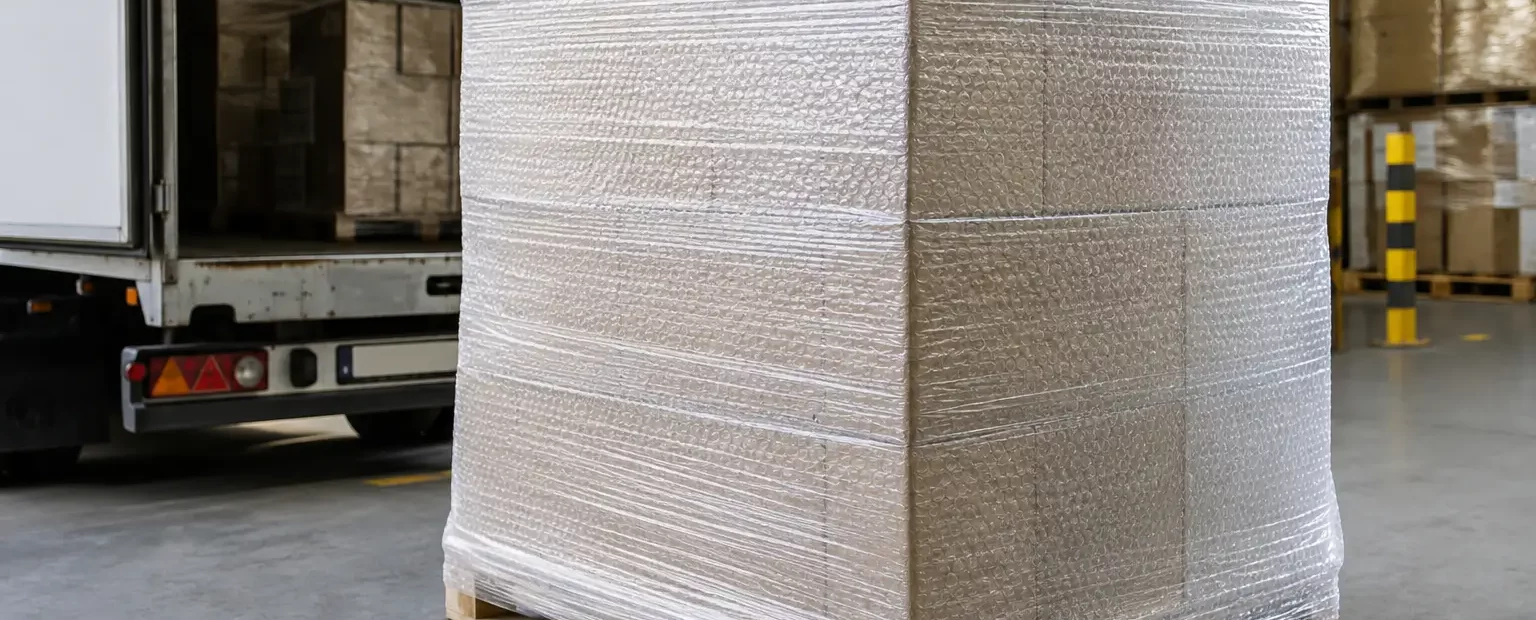
Maintaining the correct temperature during transportation does not always require a refrigerated truck. In many shipments, particularly over short and medium distances, it is possible to preserve the cold chain by using insulating materials that reduce heat transfer between the goods and the external environment.
At Foamland, we have been manufacturing protective and insulation solutions since 1987. We work with industrial companies, logistics operators, and distributors that need to protect their products during transport without unnecessarily increasing their operating costs.
Our experience as manufacturers allows us to tailor each solution to the type of goods, pallet format, and the expected transport conditions.
What does maintaining the cold chain during shipping mean?
The cold chain consists of keeping a product within a specified temperature range from preparation through to final delivery.
A break in the cold chain can affect various types of goods, including:
- Food products.
- Pharmaceutical products.
- Temperature-sensitive cosmetics.
- Chemical products.
- Industrial components that must be protected from condensation or sudden temperature fluctuations.
The risk does not come solely from the outside temperature. Thermal bridges can also develop within the packaging itself, especially when goods are transported on standard pallets.
The problem of thermal bridges in pallets
Wooden pallets allow air to circulate freely and can easily transfer heat or cold from the floor, the vehicle, or the surrounding environment.
During loading, while waiting at the loading dock, or throughout standard transportation, the temperature can change from the base and sides of the pallet. Over several hours, these accumulated changes may compromise the thermal stability of the product.
For this reason, many companies apply insulating materials around the load before wrapping it with stretch film. The aim is to create a continuous protective barrier and reduce the areas through which heat can enter or escape.
Insulating bubble wrap as a solution for maintaining temperature
One of the most practical solutions is to completely wrap the pallet with insulating bubble wrap for packaging and thermal protection. This creates a barrier that reduces heat exchange with the external environment.
The material incorporates sealed air chambers that slow down heat transfer. This helps maintain the initial temperature of the goods for longer and reduces sudden temperature fluctuations during transport.
This solution is particularly useful when:
- The transport lasts only a few hours.
- There are significant differences between warehouse and outdoor temperatures.
- The goods spend time at loading docks or waiting areas.
- Logistics providers without refrigerated vehicles are used.
- Temporary protection against ambient heat or cold is required.
Benefits of using insulating bubble wrap in logistics
- Reduces sudden temperature fluctuations: The insulation slows down heat transfer between the goods and the surrounding environment. It does not generate cold, but it helps preserve the product’s initial temperature for longer.
- Helps eliminate thermal bridges: A properly fitted insulating wrap reduces direct heat transfer between the load, the pallet, and the surrounding environment. For optimum performance, it is important to cover the base, sides, and top of the pallet.
- Reduces the risk of condensation: Rapid temperature changes can cause moisture to form on certain products or packaging materials. An insulating barrier helps moderate these fluctuations and can minimise the risk of condensation.
- Provides protection against impacts and abrasion: Bubble wrap also offers mechanical protection against vibrations, minor impacts, and scuffing during handling and transport.
- Suitable for standard pallets: The solution can be applied to Euro pallets, US pallets, and other commonly used pallet formats without requiring significant changes to warehouse operations.
How to properly insulate a pallet for shipping
The effectiveness of the system depends not only on the insulating material itself but also on how it is applied. Simply protecting the sides of the pallet is not enough.
- Insulate the base of the pallet: Placing an insulating sheet between the pallet and the goods helps reduce heat transfer from below.
- Protect all sides: The insulating material should wrap continuously around the load, leaving no gaps or open joints.
- Cover the top: The top of the pallet is often exposed to heat, cold, and direct sunlight while waiting at loading docks or during transport.
- Seal all joints: Overlap the joints to prevent air infiltration and minimise weak points in the insulation.
- Stabilise the load: Once the insulation has been applied, the pallet can be secured with stretch film for logistics applications.
Based on our experience, the weakest points are usually found at the base, the corners, and the joints between insulation sheets. Although these areas may seem small, they can significantly reduce the overall effectiveness of the insulation.
When is an insulating solution sufficient?
Not every product requires refrigerated transport. In many industries, properly insulated packaging is sufficient when:
- The transport route is short or well controlled.
- Transit times are limited.
- The product starts the journey at a stable temperature.
- The objective is to prevent rapid heat gain or heat loss.
- The goods can tolerate minor temperature fluctuations within a defined range.
Each shipment should be assessed according to the product, transport duration, external temperature, and the level of thermal protection required.
Insulating bubble wrap is not a substitute for a refrigerated vehicle when the goods require an actively controlled, constant, and certified temperature throughout the entire journey. Its purpose is to slow down heat transfer, not to provide active cooling.
Factors affecting insulation performance
There is no universal answer to how long an insulated pallet will maintain its temperature. Thermal performance depends on several factors, including:
- The initial temperature of the goods.
- The outside temperature.
- The duration of the journey.
- The volume and density of the load.
- The exposed surface area.
- The quality of the sealing and joints.
- Waiting times at loading docks or outdoor storage areas.
- Direct exposure to sunlight.
Before implementing an insulation system across all shipments, we recommend carrying out trials under real operating conditions. Using temperature data loggers makes it possible to monitor how the load behaves throughout the journey and verify whether the chosen solution meets the required performance.
Additional solutions that complement thermal insulation
In many projects, we combine different packaging materials to achieve more comprehensive protection.
- Foam separators to prevent movement within the load.
- Stretch film to stabilise the pallet.
- Edge protectors and corner boards to safeguard vulnerable edges and corners.
- Top and bottom insulation sheets to create a fully enclosed thermal barrier.
- Custom-made formats that minimise trimming, joints, and handling time.
Within our range of industrial packaging solutions, we can combine protective, stabilising, and insulating materials to suit the specific requirements of each shipment.
The importance of working with a specialist manufacturer
Every supply chain operates under different conditions. The pallet dimensions, product type, transport duration, and environmental exposure all influence the level of insulation required.
At Foamland, we do more than simply supply standard packaging materials. We manufacture bespoke insulation solutions tailored to each customer’s products, shipping volumes, and packaging processes.
Frequently Asked Questions about maintaining the cold chain during shipping
Can insulating bubble wrap replace a refrigerated truck?
No. Insulating bubble wrap slows down heat transfer but does not generate cooling. For long-distance transport or products with strict temperature requirements, refrigerated transport may still be necessary.
How long can it maintain the required temperature?
It depends on the initial product temperature, ambient conditions, load volume, transit time, and the quality of the insulation seal. Performance should always be validated through testing under real operating conditions.
Is it important to insulate the base of the pallet?
Yes. The base is one of the main points of thermal transfer. Insulating it helps minimise direct heat exchange between the goods, the pallet, and the ground.
Can it be used with any pallet format?
Yes. The material can be adapted to Euro pallets, US pallets, and most other pallet formats commonly used in industrial logistics.
Can custom sizes be manufactured?
Yes. As manufacturers, we can produce bespoke formats tailored to the dimensions of the load and the packaging process used by each customer.
Key takeaways on maintaining the cold chain in logistics
Maintaining the cold chain in logistics does not always require refrigerated vehicles. For controlled transport operations, a well-designed insulation solution can minimise thermal bridges, protect sensitive goods, and optimise distribution costs.
The key is to create a continuous thermal barrier, insulate the base of the pallet, and validate the system’s performance under real transport conditions.
If you are planning to transport goods by sea, you may also find it useful to read about the thermal risks associated with maritime freight transport and how to prevent them.
Do you need to protect temperature-sensitive goods during transport?
At Foamland, we assess your product, pallet configuration, and transport conditions to recommend a practical insulation solution tailored to your logistics operation.
Contact our team to request further information or a bespoke insulating bubble wrap solution manufactured to your exact requirements.
Our in-house manufacturing capabilities enable us to customise dimensions, formats, and production volumes. This also helps us maintain consistent quality across repeat orders while reducing material waste during pallet preparation.
From our manufacturing facility in Sabadell, we work with companies that require practical, reliable, and easy-to-integrate insulation solutions for their logistics operations.