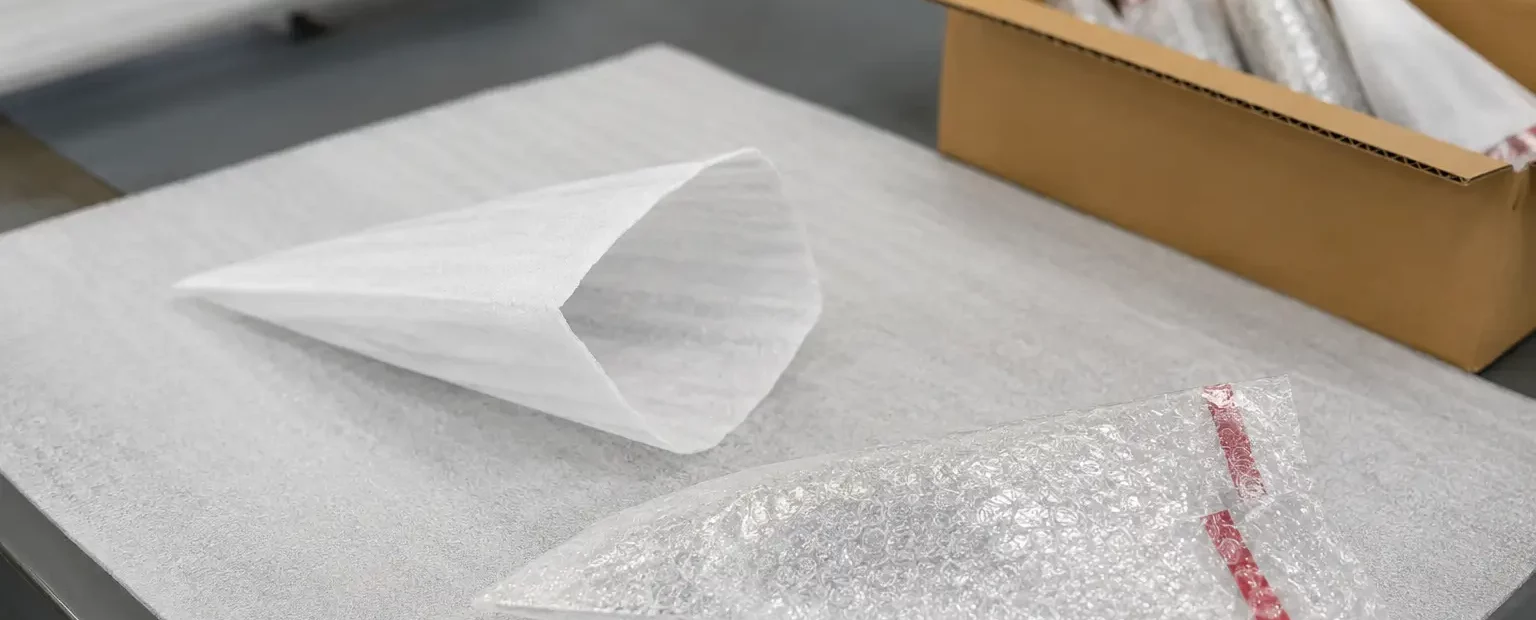
Foam bags and bubble wrap bags solve the same challenge: protecting products before, during, and after transportation. The difference lies in how they achieve that protection.
At Foamland, we have been manufacturing packaging materials since 1987, and we know that choosing the right solution helps prevent marks, breakages, returns, and wasted time on packing lines.
What are foam bags?
Foam bags, also known as foam packaging bags, are made from a lightweight and flexible protective foam sheet. Their main purpose is to protect the surface of the product.
They are an excellent choice when the priority is preventing abrasion, micro-scratches, dust, or marks during handling. They perform particularly well with lacquered, chrome-plated, painted, varnished, or otherwise delicate finished products.
At our factory, we typically recommend them when a product does not require significant cushioning but does need clean, uniform, and easy-to-apply surface protection.
What are bubble wrap bags?
Bubble wrap bags feature a layer of encapsulated air that helps absorb shocks, vibrations, and minor impacts. This is why they are commonly used in logistics, spare parts distribution, e-commerce, industrial components, and fragile products.
Bubble wrap adds more volume than foam, but it also provides greater cushioning capacity. It is a practical solution when products may be exposed to impacts during transportation or when the outer packaging alone cannot provide sufficient protection.
Within our range of custom packaging bags, we manufacture various formats to adapt protection to the type of component, packing speed, and shipping requirements.
Main differences between foam bags and bubble wrap bags
| Feature | Foam Bags | Bubble Wrap Bags |
|---|---|---|
| Main Function | Surface protection | Impact cushioning |
| Recommended Products | Delicate, lacquered, painted, or polished parts | Fragile products, spare parts, components, and shipments |
| Volume | Lower volume | Higher volume |
| Handling | Very fast and clean | Fast, with greater impact protection |
| Typical Use | Separation, presentation, and abrasion protection | Transportation, shipping, and shock protection |
Advantages of foam bags
- They protect delicate finishes: The main advantage of foam is its softness. It wraps the product without marking it and reduces the risk of friction between items. This is why it is widely used in industries where the visible finish is just as important as the product itself.
- They take up very little space: Foam bags are lightweight and compact. This helps optimise storage and makes packaging workstations more efficient when space is limited.
- They improve product presentation: When customers open the box, the product arrives clean and well protected. For technical parts, commercial samples, or products with sensitive finishes, this detail communicates care and professionalism.
Advantages of bubble wrap bags
- They absorb impacts more effectively: The air chambers act as cushions. This makes them an effective solution for products that may experience impacts during transportation, especially when shipments involve multiple handling stages.
- They are highly versatile: Bubble wrap bags are suitable for a wide range of industries, including electronics, spare parts, hardware, cosmetics, e-commerce, glassware, ceramics, and promotional products.
- They speed up order fulfilment: A pre-formed bag eliminates the need to cut, wrap, and seal each item manually. For repetitive packing operations, this can make a significant difference.
When to use foam bags
We recommend foam bags when the main risk is abrasion rather than impact. They are suitable for:
- painted, lacquered, or varnished products,
- polished metal components,
- profiles, panels, or flat parts,
- products shipped inside an already protected box,
- items that require individual separation.
They can also be combined with separator formats when packaging requires internal organisation and layer-to-layer protection.
When to use bubble wrap bags
Bubble wrap bags are more suitable when products require protection against impacts, pressure, or vibration. We recommend them for:
- fragile products,
- industrial spare parts and components,
- e-commerce orders,
- small items exposed to impact risks,
- individual shipments or high-turnover products.
When products require more comprehensive protection, bubble wrap bags can also be combined with cushioning and protective solutions to reinforce the outer packaging.
Which type of bag is best for your product?
The decision should not be based solely on price or habit. It is important to evaluate three key factors: the product finish, the transportation method, and the packing workflow.
If the product scratches easily, choose foam. If it may break or suffer impacts, choose bubble wrap. If it needs both types of protection, we can develop a combined solution.
At Foamland, we manufacture custom solutions because every production line operates differently. Protecting a heavy industrial component is not the same as protecting a lightweight online retail product. Packaging should adapt to the product, not the other way around.
Frequently asked questions about foam bags and bubble wrap bags
Are foam bags suitable for fragile products?
Yes, but with limitations. They are designed to protect surfaces rather than absorb major impacts. If a product is fragile, a bubble wrap bag or a combination of materials is usually the better choice.
Are foam packaging bags the same as foam bags?
Yes. Both terms are commonly used within the industry to describe bags made from flexible protective foam.
Can bags be manufactured to custom sizes?
Yes. At Foamland, we can adapt dimensions, thicknesses, and formats according to the product, order volume, and packaging system.
Which option is better for preventing scratches?
For preventing scratches and surface marks, we generally recommend foam bags. They are soft, lightweight, and provide excellent protection for delicate finishes.
Final comparison: foam bags vs bubble wrap bags
Foam bags and bubble wrap bags are not competitors. They solve different problems. Foam protects surfaces. Bubble wrap cushions impacts.
When chosen correctly, packaging stops being a generic expense and becomes a protection solution tailored to the product, transportation requirements, and actual workflow.
Need custom foam bags or bubble wrap bags?
At Foamland, we manufacture packaging bags for industrial companies, logistics operations, and e-commerce businesses. Tell us what product you need to protect, and we will help you choose the most suitable format.
Contact us for more information or to request a custom packaging solution.