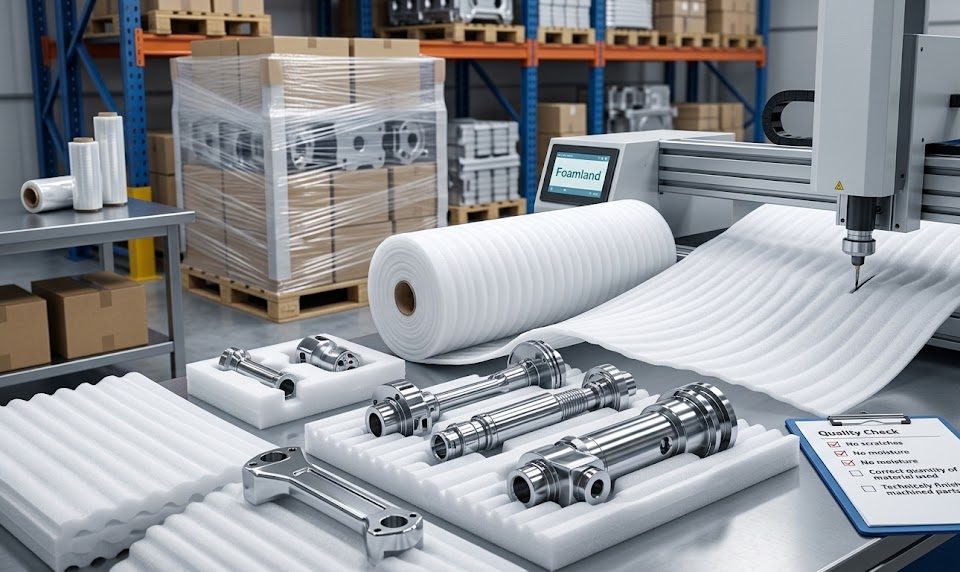
Metal parts are one of the most delicate products to protect during industrial transport. Not because of structural fragility, but because of something far more common: friction, vibrations, moisture, oxidation or small impacts that end up causing returns, rejections or production issues.
In sectors such as automotive, machining or heavy industry, a simple scratch can render a finished part unusable.
The good news is that proper protection does not mean spending more. In many cases, quite the opposite: well-designed industrial packaging reduces incidents, optimizes space and prevents extra logistics costs.
At Foamland, we have been manufacturing industrial packaging solutions for companies since 1987 where materials arrive directly at the production or assembly line. We know that the goal is not to wrap more, but to protect better with the minimum material required.
What problems do metal parts suffer during transport?
Each sector has its own particularities, but the problems tend to repeat themselves:
- Micro-impacts between parts.
- Friction during handling.
- Moisture and condensation.
- Vibrations on pallets or in boxes.
- Pressure deformations.
- Dirt or surface contamination.
In machined parts or automotive components, this damage often appears even before the goods reach the end customer. Many times, it happens inside the warehouse itself or during internal movements.
That is why packaging for metal parts must be designed with the entire journey in mind, not just external transport.
The most common mistake: using more material than necessary
It is common to think that more protection means more layers, more cardboard or more filling. We have already identified the common mistakes in industrial packaging that cause damage. In reality, this usually leads to:
- Higher logistics costs.
- More storage volume.
- Longer handling times.
- Greater material consumption.
- Worse product presentation.
The key is to adapt the material to the type of part.
A small machined part does not need the same protection as a heavy metal structure. Nor does a lacquered, chrome-plated or technically finished part require the same system.
That is why, in our factory, we focus heavily on custom packaging and formats adapted to each client. The goal is to avoid unnecessary material and protect only where needed.
Which materials work best for protecting metal parts?
When we talk about industrial packaging, it is worth looking closely at which specific materials best protect the type of product you are handling. Choosing the right industrial protection supplier is important in this regard.
If you work with metal parts, these are some of the best materials for packaging them:
Polyethylene foam
Foam is one of the most effective solutions for preventing friction and micro-impacts.
It has several industrial advantages:
- Very lightweight.
- Flexible.
- Non-abrasive.
- Easy to die-cut or adapt.
- Reduces vibrations.
- Takes up little space.
It is widely used in automotive, machining and electronic components because it protects delicate surfaces without marking the part.
In many cases, we combine technical formats with our technical foams for industrial packaging to create custom separators or interiors.
Foam rolls
When volume is high and operational speed is needed, foam rolls remain one of the most cost-effective options.
They allow parts to be wrapped quickly and protect edges, surfaces or sensitive areas without adding too much weight to the packaging.
They are also very useful as intermediate protection between stacked metal parts.
You can view our foam rolls for industrial applications, designed for packaging, separation and protection in demanding logistics processes.
Sheets and separators
For heavy parts or machined components with complex geometries, technical sheets and internal separators make it possible to immobilize the product and prevent movement.
This greatly reduces vibration damage during transport.
In addition, when packaging is well designed, it also improves order preparation times and internal organization.
In industrial sectors, this has a direct impact on operating costs.
Industrial stretch film
Many incidents do not come from individual packaging, but from pallet stability.
Poor stretch wrapping causes movement, falls or uneven pressure between boxes.
That is why the correct use of industrial stretch film and minifilm remains essential to protect metal components during transport and storage.
How to reduce costs without reducing protection
Adjust the material to the real risk
Not all parts need complex packaging. Many times, it is enough to ensure:
- Proper separation.
- Light surface protection.
- Pallet stability.
- Avoiding metal-to-metal contact.
By reducing excess, a lot of material can be saved.
Design custom formats
When packaging is designed for the part:
- Less material is consumed.
- Handling time is reduced.
- Storage improves.
- Incidents decrease.
At Foamland, we regularly work with custom formats for industrial lines where every operational second counts.
Avoid invisible damage
Many costs do not appear on the packaging invoice:
- Returns.
- Claims.
- Production stoppages.
- Reprocessing.
- Loss of image.
A damaged metal part can cost far more than all the protection used.
Industrial packaging for automotive and machining
In automotive and machining, the level of demand is especially high.
Parts usually have:
- Minimal tolerances.
- Delicate finishes.
- Surface treatments.
- Very specific logistics requirements.
That is why industrial packaging for automotive must be integrated into the production process.
The following work especially well here:
- Technical separators.
- Die-cut foam.
- Edge protectors.
- Surface protection.
- Custom interiors.
It is also common to combine different solutions depending on the logistics phase. For example:
- Light protection for internal storage.
- Reinforced packaging for shipments.
- Reusable formats for recurring transport.
The importance of well-designed industrial packaging
Many companies see packaging as an unavoidable cost. We see it as a tool for industrial efficiency.
Well-designed packaging:
- Reduces incidents.
- Improves times.
- Protects quality.
- Optimizes space.
- Conveys professionalism to the customer.
That is precisely why one of our areas of work is to strengthen solutions aimed at specific industrial sectors such as automotive, machining, heavy industry and technical components.
What we recommend before choosing a protection system
Before deciding on a material, it is worth analyzing:
- Weight of the part.
- Surface finish.
- Type of transport.
- Internal handling.
- Stacking.
- Humidity.
- Shipping frequency.
With this information, it is much easier to choose a cost-effective and truly efficient solution. There is no single packaging solution suitable for all metal parts. There is the right packaging for each process.
Adapt the protection of your metal parts to the product, not the other way around
Protecting metal parts during transport is not about adding more material, but about using the right material. When industrial packaging is well designed, incidents are reduced, costs are optimized and the entire logistics operation improves.
At Foamland, we manufacture industrial protection solutions adapted to every company, every part and every process. We work with sectors where packaging cannot fail, from automotive to machining or heavy industry.
If you need to improve the protection of your metal parts without driving up costs, contact us. We will study your case and help you find the most suitable format for your industrial packaging system.